
Sunday, December 15, 2013
TOW #13 Settlers of Catan Family Edition Game Directions
My family loves the Settlers of Catan board game and we play it a lot. This week I examined the directions for the family edition, which is slightly different than the normal version in its directions and game components. The obvious purpose of the game rules is to explain to the users how to play the game. In order to achieve this, the directions have to be straightforward, helpful, and easy to read, so delivery is very important. They also cannot be to long and complicated as this version of the game is targeted at families. The rules are organized under headings such as "Setting Up the Game", "The Turn in Detail", and "Ending the Game". These are presented in chronological order of how they occur during game play. This is the clearest way to explain the game. Important notes are in blue italics, contrasting to the black normal type, to get the reader's attention. Bullets are used to make lists to organize information more clearly for the reader. Included among the written directions are lots of pictures of the game board, all its components, and possible scenarios. These help visually illustrate how the game is played and allow the players to understand what pieces correspond with the descriptions in the written directions. Though perhaps not the primary purpose, the pictures add color and make the instructions more visually interesting, keeping the players attention and motivating them to read the directions to reach the point of understanding the game. The written directions also include possible scenarios. For example, under the heading "The Turn in Detail", the instructions state "Example: Loren rolls a '4'. Her blue city 'A' borders a fields hex marked with the number '4', so she takes two grain cards." The instructions are not just laid out but a potential scenario applying those instructions is given to help the reader understand how he or she will use the instructions to play the game. Ultimately, through strategic delivery, these game board instructions effectively achieve the goal of explaining verbally and visually how to play the game.


Sunday, December 8, 2013
TOW #12 Frozen Movie Poster Visual
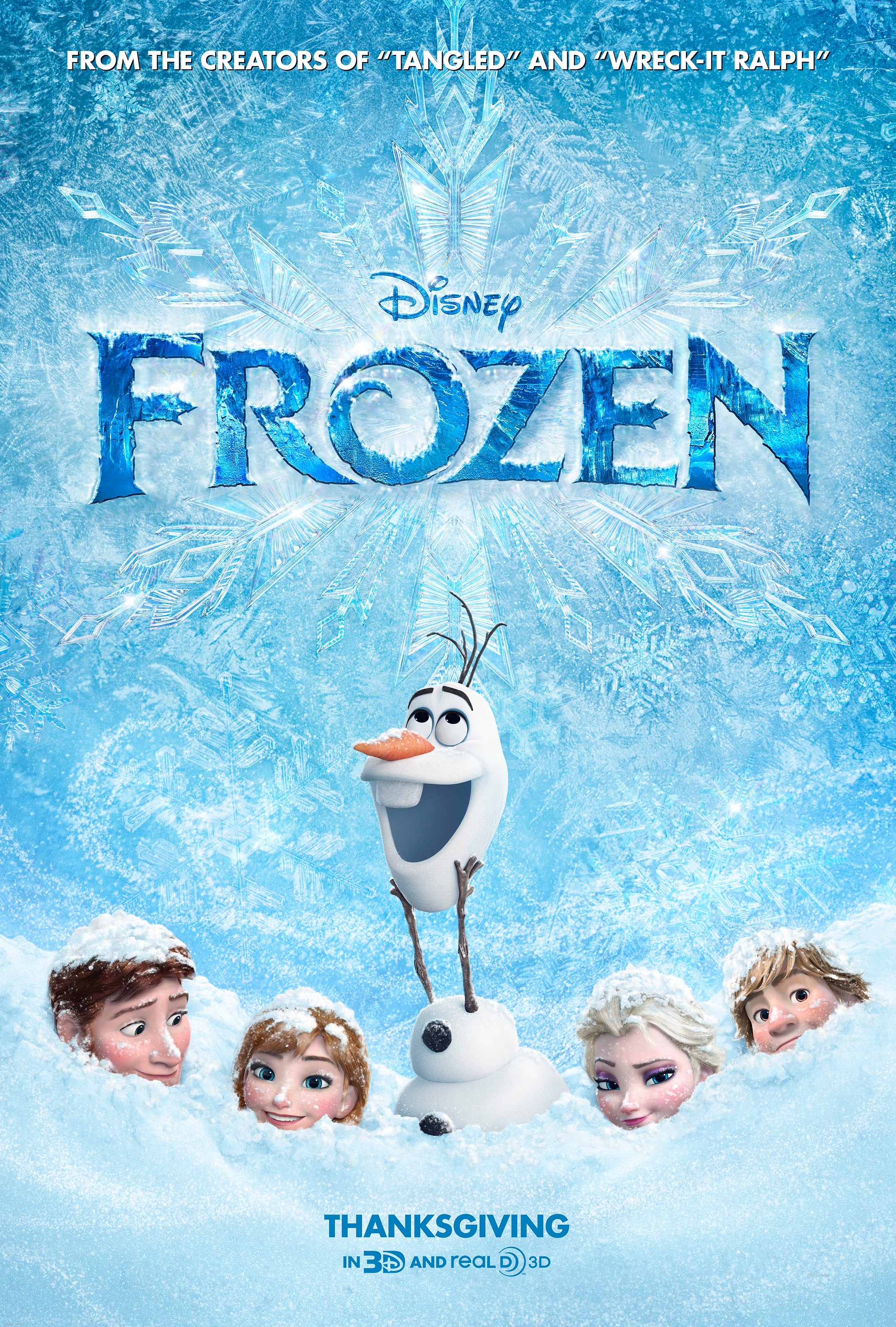
Here is a movie poster for the Disney movie Frozen which came into theaters on Thanksgiving a little over a week ago. The obvious purpose of this (and any) movie poster is to get the audience to come see the movie. However, in this particular case, Disney and the designers of this poster face a challenge in that it should ideally appeal to both the audience of young children to which Disney movies are traditionally aimed, as well an older audience of teenagers and adults who also the quality of an animated Disney movie. Being the insanely successful and world famous company that it is, Disney, brings an established credibility to the advertisement, and the movie, just by having its logo on the poster. The logo is noticeably placed front and center above the title of the film where no viewer can possibly miss it. The poster also increases it's ethos by including text at the top which states "from the creators of 'Tangled' and 'Wreck-It Ralph'". This poster implicitly argues that the movie "Frozen" will be just as good as Tangled and Wreck-It Ralph because it is made by the same people. This automatically piques the interest of an audience of people who did like these two previous movies. In my own case, this is what convinces me that I want to see the movie. Because I loved the movie Tangled, I am eager to go see this movie if there is any chance that it will be as good. Also, the positioning of the characters attempts to convince the audience to come see the movie. The four human characters are up to their heads in snow, but the poster doesn't give us really any clues to why or how or really what is going on in the movie at all, so that could potentially inspire an interest to find out what happens. Then, of course, there is the snowman in the middle, holding his own head. Such prominent placement of such a goofy, unrealistic character lets the audience know right away that this is going to be a family-friendly, happy, funny movie.
Tuesday, December 3, 2013
TOW #11 IRB Post
In the opening chapters of his book Blink: The Power of Thinking Without Thinking, Malcolm Gladwell introduces the idea that when it comes to the human subconscious, a little information can go a long way. According to Gladwell, our brains use a process called "thin-slicing", in which they use limited information received over a short period of time to make judgments about a situation. These judgments, as demonstrated by the examples and studies Gladwell includes, are often remarkably accurate. The ideas Gladwell presents are interesting and supported by a variety of anecdotes and statistics. One section describes how by witnessing and analyzing samples of one conversation of a married couple, a man named John Gottman can predict whether or not their relationship will end in divorce. Then an experiment is explained in which people were able to determine certain aspects of a college student's personality simply by observing his or her dorm room. In further explaining the same idea, Gladwell writes about research that showed a doctor's likeliness to be sued could be judged based on something as simple as his or her tone of voice when talking to a patient. However, not only does Gladwell write about how unconscious judgments can help people make accurate conclusions but also how they can cause people to make mistakes. Gladwell cites examples of unconscious associations people make base on race or visual appearance that stereotype individuals. The array of stories and studies that Gladwell describes not only maintain the interest of the reader, but strengthen his idea by showing how the importance of unconscious thinking is observable and applicable in real life. They show the reader that this is not a wild idea pulled out of nowhere but a theory that has demonstrated to be be true in a variety of situations. The reader can see how these ideas make sense, and perhaps even recognize the role unconscious thinking plays in their own reactions.
Subscribe to:
Comments (Atom)