http://www.huffingtonpost.com/2014/01/28/the-unusual-college-major_n_4654757.html
In our society today, higher education in the humanities is often looked down upon in favor of areas such as law, business, medicine, engineering etc. These are considered successful career areas because they are money-makers, while an education in the humanities is associated with unemployment and lack of income. This article from the Huffington Post by Carolyn Gregoire challenges these stereotypes by demonstrating how education in the humanities is important and leads to success. First, the author points out that future income is not necessarily the best way to determine what is a good major, and that it is more important for students to study what they love as they will be more likely to work to success in that area. Then Gregoire spends the rest of the article supporting her argument with 10 examples of well-known figures who were humanities majors in college and who have since been very successful. Some of the people she cites include 2012 Republican presidential candidate Mitt Romney (English major), former CEO of HP Carly Fiorina (Medieval History and Philosophy major), famed author J.K.Rowling (French and Classics major), director Steven Spielberg (English major), and host of "The Daily Show" Jon Stewart (Psychology major). For each example, Gregoire included a picture of the person and a brief education and career history. Some of the people ended up in successful careers very different from what they actually studied in college. As Gregoire shows, the background education in an area of humanities gives students and wider experience base to build on later in life, one that can be applicable to many different areas. Philosophy major and co-founder of Flickr Steward Butterfield, another featured person, is quoted as saying "'...if you have a good background in what it is to be human, an understanding of life, culture and society, it gives you a good perspective on starting a business, instead of an education purely in business,'" (Gregoire par. 24). This quote helps to demonstrate how an education in the humanities can be important and useful no matter what career a student may end up in, while other career specific skills can be picked up in later training. Gregoire uses these ten people as living and, as the title says, "irrefutable" evidence that a humanities education is important to the future success of a student.
Sunday, February 2, 2014

Monday, January 20, 2014
TOW #16 "A Time to Break Silence"
Today being Martin Luther King Day I decided to read one of his speeches. The "I have a dream" speech immediately comes to mind at the thought of Dr. King, but I wanted to read one of his less famous speeches, so I chose an excerpt from "Beyond Vietnam: A Time to Break Silence". In this speech, Dr. King protests the war in Vietnam and calls on the government and people of the United States to bring an end to it. He begins by explaining why he protests the war. Among his reasons he lists that the expense of the war is detrimental to the attempts to help the poor in the United States, that it forces the poor to fight in Vietnam for rights or privileges that they don't have at home, and above all that the fighting is not on behalf of the Vietnamese people and it is destroying their society. After enumerating the crimes of the war, Dr. King calls on the US government to put an end to the war. He lists five steps to achieving this goal, to show that it can and must be done. He also appeals to the American people and asks them to peacefully protest to pressure the government to end the war. Throughout the speech, Dr. King uses many rhetorical questions. For example, he asks "What do they [the Vietnamese people] think as we test out our latest weapons on them, just as the Germans tested out new medicine and new tortures in the concentration camps of Europe? Where are the roots of the independent Vietnam we claim to be building?" (King par. 19). These questions serve to drive home the points to the audience, to get them to seriously consider the US actions in Vietnam and what should be done about them. They also question the motives and morality of the US government, and call for change. Ultimately, they help Dr. King connect to the thoughts of the audience and to call them to help bring an end to the war.
Here is where I found the excerpt of the speech: http://www.informationclearinghouse.info/article2564.htm
Here is where I found the excerpt of the speech: http://www.informationclearinghouse.info/article2564.htm
Sunday, January 12, 2014
TOW #15 "The Book of the Future" Visual

Sunday, January 5, 2014
TOW #14 IRB Post
In the second half of Blink, Malcolm Gladwell continues to explore how the brain's unconscious thinking works, as well as the power and implications of this kind of thinking. Though the unconscious has the ability to pick up on details and rapidly make accurate assessments, there are times when it can be wrong. Gladwell explains how one can become "mind blind" when one's thinking narrows during high stress situations, or how judgement can be influenced by stereotypes and prejudices unconsciously. Again, Gladwell uses anecdotes from real events and evidence from studies to convincingly support his ideas. Each chapter in the book is organized around one main story that deals with an aspect or idea of unconscious thinking, and then throughout the chapter it is analyzed with support from other anecdotes, events, or research. For example, in the chapter "Seven Seconds in the Bronx", Gladwell tells the story of a police shooting in New York City in 1999, in which a young man was killed by the police because they thought he was acting suspiciously and they thought he had a gun. In the chapter, Gladwell goes into depth on the story, then cites cases of other police brutality stories and introduces the idea of mind-blindness. Ultimately, he analyzes the anecdote to show how our unconscious can drastically mislead us in fast moving situations of overwhelming stress, and how we need to understand this and be able to control it. In the conclusion of the book, Gladwell writes about a female trombonist who made it into the Munich Philharmonic Orchestra in a blind audition, but was demoted and discriminated against when it was discovered that she was female. With this story he explores the issue of the lack of women in professional orchestras before the blind audition process was established. When the judges could see the performers, their opinions were unconsciously influenced by the gender of the performer, as well as their posture and demeanor, and their instrument, thus letting their personal prejudices affect their decisions. The important part of this story, Malcolm Gladwell emphasizes, is that the problem was fixed by the implementation of blind auditions. This story at the end of the book, ultimately reinforces Gladwell's purpose: to make the audience aware of how their unconscious thinking works so that they can understand it and train it to use it better. He gets his message across strongly and effectively because his evidence and research and his analysis of these shows the reader the ideas and how they are influential in real life.
Sunday, December 15, 2013
TOW #13 Settlers of Catan Family Edition Game Directions
My family loves the Settlers of Catan board game and we play it a lot. This week I examined the directions for the family edition, which is slightly different than the normal version in its directions and game components. The obvious purpose of the game rules is to explain to the users how to play the game. In order to achieve this, the directions have to be straightforward, helpful, and easy to read, so delivery is very important. They also cannot be to long and complicated as this version of the game is targeted at families. The rules are organized under headings such as "Setting Up the Game", "The Turn in Detail", and "Ending the Game". These are presented in chronological order of how they occur during game play. This is the clearest way to explain the game. Important notes are in blue italics, contrasting to the black normal type, to get the reader's attention. Bullets are used to make lists to organize information more clearly for the reader. Included among the written directions are lots of pictures of the game board, all its components, and possible scenarios. These help visually illustrate how the game is played and allow the players to understand what pieces correspond with the descriptions in the written directions. Though perhaps not the primary purpose, the pictures add color and make the instructions more visually interesting, keeping the players attention and motivating them to read the directions to reach the point of understanding the game. The written directions also include possible scenarios. For example, under the heading "The Turn in Detail", the instructions state "Example: Loren rolls a '4'. Her blue city 'A' borders a fields hex marked with the number '4', so she takes two grain cards." The instructions are not just laid out but a potential scenario applying those instructions is given to help the reader understand how he or she will use the instructions to play the game. Ultimately, through strategic delivery, these game board instructions effectively achieve the goal of explaining verbally and visually how to play the game.


Sunday, December 8, 2013
TOW #12 Frozen Movie Poster Visual
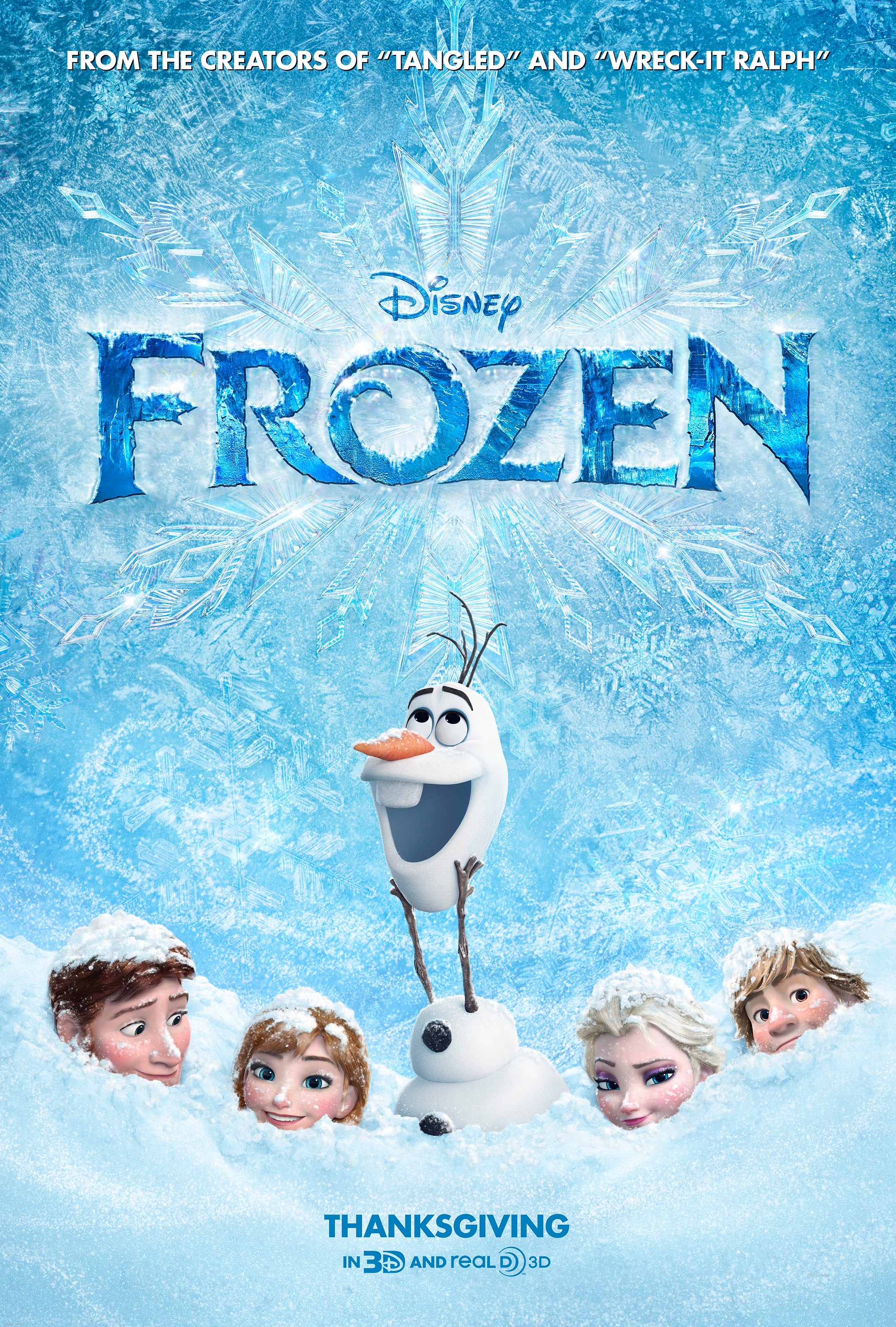
Here is a movie poster for the Disney movie Frozen which came into theaters on Thanksgiving a little over a week ago. The obvious purpose of this (and any) movie poster is to get the audience to come see the movie. However, in this particular case, Disney and the designers of this poster face a challenge in that it should ideally appeal to both the audience of young children to which Disney movies are traditionally aimed, as well an older audience of teenagers and adults who also the quality of an animated Disney movie. Being the insanely successful and world famous company that it is, Disney, brings an established credibility to the advertisement, and the movie, just by having its logo on the poster. The logo is noticeably placed front and center above the title of the film where no viewer can possibly miss it. The poster also increases it's ethos by including text at the top which states "from the creators of 'Tangled' and 'Wreck-It Ralph'". This poster implicitly argues that the movie "Frozen" will be just as good as Tangled and Wreck-It Ralph because it is made by the same people. This automatically piques the interest of an audience of people who did like these two previous movies. In my own case, this is what convinces me that I want to see the movie. Because I loved the movie Tangled, I am eager to go see this movie if there is any chance that it will be as good. Also, the positioning of the characters attempts to convince the audience to come see the movie. The four human characters are up to their heads in snow, but the poster doesn't give us really any clues to why or how or really what is going on in the movie at all, so that could potentially inspire an interest to find out what happens. Then, of course, there is the snowman in the middle, holding his own head. Such prominent placement of such a goofy, unrealistic character lets the audience know right away that this is going to be a family-friendly, happy, funny movie.
Tuesday, December 3, 2013
TOW #11 IRB Post
In the opening chapters of his book Blink: The Power of Thinking Without Thinking, Malcolm Gladwell introduces the idea that when it comes to the human subconscious, a little information can go a long way. According to Gladwell, our brains use a process called "thin-slicing", in which they use limited information received over a short period of time to make judgments about a situation. These judgments, as demonstrated by the examples and studies Gladwell includes, are often remarkably accurate. The ideas Gladwell presents are interesting and supported by a variety of anecdotes and statistics. One section describes how by witnessing and analyzing samples of one conversation of a married couple, a man named John Gottman can predict whether or not their relationship will end in divorce. Then an experiment is explained in which people were able to determine certain aspects of a college student's personality simply by observing his or her dorm room. In further explaining the same idea, Gladwell writes about research that showed a doctor's likeliness to be sued could be judged based on something as simple as his or her tone of voice when talking to a patient. However, not only does Gladwell write about how unconscious judgments can help people make accurate conclusions but also how they can cause people to make mistakes. Gladwell cites examples of unconscious associations people make base on race or visual appearance that stereotype individuals. The array of stories and studies that Gladwell describes not only maintain the interest of the reader, but strengthen his idea by showing how the importance of unconscious thinking is observable and applicable in real life. They show the reader that this is not a wild idea pulled out of nowhere but a theory that has demonstrated to be be true in a variety of situations. The reader can see how these ideas make sense, and perhaps even recognize the role unconscious thinking plays in their own reactions.
Subscribe to:
Posts (Atom)